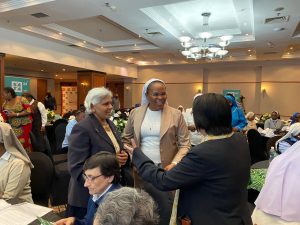
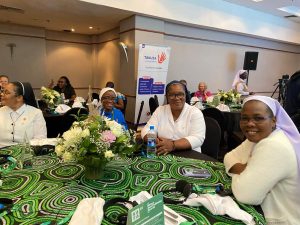
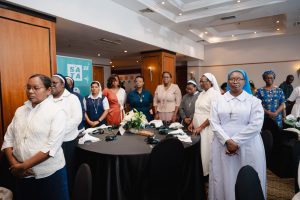
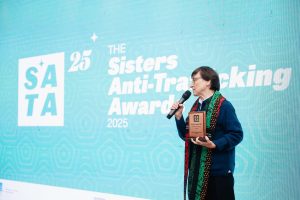
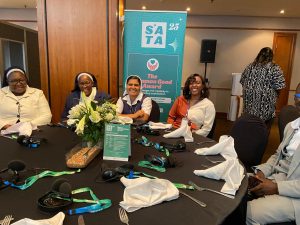
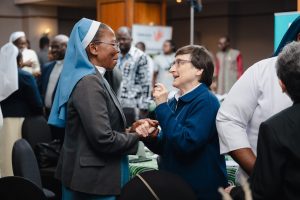
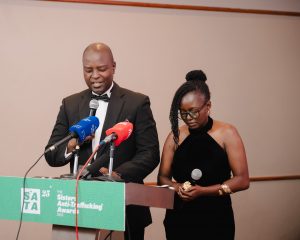
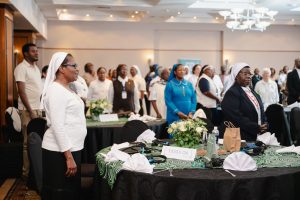
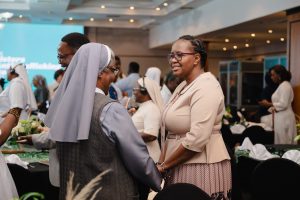
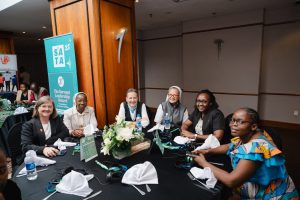
3rd Edition of Sister Anti-Trafficking Awards hosted in Zambia
“Not only to Hope for change but to be Instruments of it”
In her opening remarks, Sr Jane Wakahiu, Associate Vice President. Program Operations and Head of Catholic Sisters Conrad N. Hilton Foundation set the tone for the evening, stating that “the SATAs are a summons to system change and a reminder that protection for those at risk must be bold and collective.” Drawing on Mark 5:41 — “Talitha Kum — Little girl, I say to you, arise” — Sr Jane invited everyone in the room to consider: What is yours to do? Her words carried the night with a scriptural reminder that the work of justice is both spiritual and practical.
The Keynote speaker, Cardinal Spephen Brislin, Archbishop of Johannesburg echoed this conviction. “Faith without action fails the poor. Human trafficking reduces God’s children to objects,” he said. It strips people of freedom and dignity; it destroys families and rubs communities of their future. As people of faith, he insisted, silence is not an option.
Panel Discussion: The Scope of the Crisis and Why Sisters Must Be Central
A dynamic panel moderated by the talented Kunda Mando brought together Pauline Akinyi Juma (Kenya), founder and director of Rebirth of a Queen, Sr. Rosemary Nyirumbe (Uganda), Director of a shelter, Sr. Kayula Lesa (Zambia), Coordinator of Talitha Kum Zambia (TAKUZA) and Kevin Hyland (UK), Chairperson of Arise Foundation Board, who confronted uncomfortable truths about human trafficking and offered responses rooted in experience, justice and faith.
Mr Hyland laid out the hard numbers: 50 million victims worldwide, more than a quarter of them children; 22,000 children die each year in exploitative labour conditions and how traffickers make an estimated USD 236 billion annually. Despite this, G20 countries invest less than USD 1 billion into counter-trafficking efforts. The result is devastating: only 2% of victims are ever identified and the chance of traffickers being held accountable is, as he put it, “next to none.” “This industry is making trillions while governments under-report what they fund,” Kevin said bluntly.
Sisters, he said, step into places many fears: border towns, informal settlements, prisons and shelters. Their presence, he argued, reveals what is missing: consistent care, listening and the moral clarity to call exploitation by its name.
Ms Pauline, described local realities where trafficking is routinely misclassified as sexual abuse, masking the trafficking indicators: “Someone thinks they’re getting a job, their passport is confiscated and they are later sexually abused.” Such misclassification obscures the crime and aids impunity.
Sr Rosemary empathised that empowerment is not about giving survivors ‘more or less,’ but it is about restoring dignity. True recovery, she noted, begins when survivors are given platforms to tell their stories in their own words and languages.
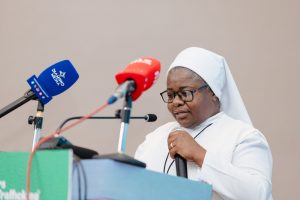
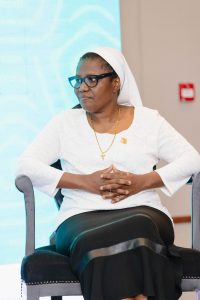
When asked why sisters are so involved, Sr Kayula pointed to the Church’s social teaching which insists on the sacred dignity of every person. “Human trafficking compromises the dignity,” she said, “a faith that does justice compels us to help restore it.” She noted that awareness campaigns, training of frontline officers, community outreach and accompaniment of survivors are not add-ons but expressions of the Gospel itself.
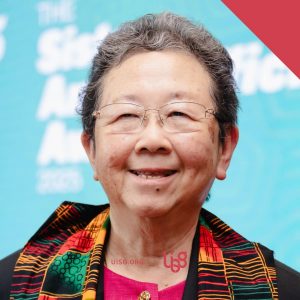
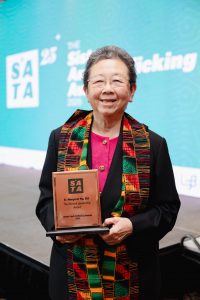
“ARE YOU EATING, USING OR WEARING SOMEBODY’S MISERY?” — Sr Margaret Ng
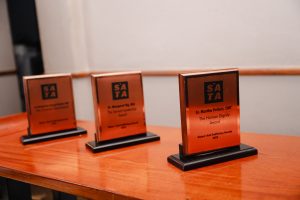
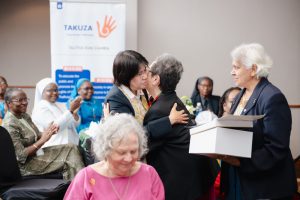
The SATA Recipients
The awards evening shone a light on sisters whose lives are a living refutation of indifference:
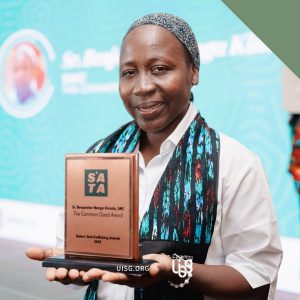
- Sr. Benjamine Nanga Kimala, SMC (Comboni Missionary Sisters) — Common Good Award
For courage and creativity in addressing exploitation across challenging contexts. - Sr. Margaret Ng, RSJ (Sisters of Saint Joseph of the Sacred Heart) — Servant Leadership Award
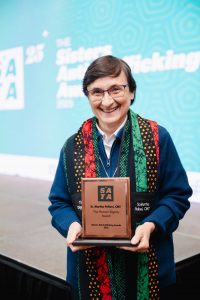
For excellence in network-building and strengthening survivor-centred models. - Sr. Martha Pelloni, CMT (Carmelitas Misioneras Teresianas) — Human Dignity Award
For lifetime achievement in defending the most vulnerable and advancing justice.
Each laureate shared testimony of survivors who shaped their mission. Sr Martha recalled a girl named Estelita, “She was 15, silenced by fear, trapped by those who were supposed to protect her. Her voice broke the silence and started a movement of healing.”
Sr Benjamine and Sr Margaret reminded the audience that trafficking is rooted in structural injustices — lack of opportunity and gender violence and Called for Justice, Not Charity, As the Answer.
Closing Reflections: From Celebration to Sustained Action
In closing reflections, Sr Valeria Kabaso, President of the Zambia Association of Sisterhoods, stressed that the awards are not an endpoint but a renewed call to collective action. “The scale of trafficking is too large for any single organization,” she affirmed, thanking partners for bridging the grassroots wisdom of Religious Sisters with the broader civil society and ensuring that survivor-centred approaches remain at the heart of policy and practice.
If one message from the General Assembly and the SATAs that lingers, it is this: YOU CAN BE PART OF THE SOLUTION. Whether by sharing protective information, supporting survivor services, advocating for honest investment or making ethical choices in our daily lives each action, however small, carries weight.
As the sisters demonstrated again and again, faith requires action. In their witness, mercy becomes resistance; tenderness becomes justice. Through their work, those once silenced are seen, heard and slowly, allowed to arise.